

A widespread and dangerous assumption persists across Canadian boardrooms and executive suites: that cybercriminals exclusively target Fortune 500 enterprises, national infrastructure, and major financial institutions.
The empirical reality paints a vastly different picture. Approximately one in six Canadian businesses reports experiencing a material cyber incident each year, and small to mid-sized organizations now account for the overwhelming majority of opportunistic ransomware deployments. Threat actors rarely spend weeks manually sizing up a target's market capitalization before deploying their payloads; instead, modern threat campaigns rely on continuous, automated reconnaissance bots scanning the public internet for unpatched perimeter vulnerabilities, exposed API endpoints, and misconfigured access credentials.
If an attack surface is exposed, automated scripts exploit it. To an automated credential stuffer or vulnerability scanner, a 15-person regional distributor looks identical to a multinational conglomerate.
The Asymmetric Exposure of Growing Firms
While large global corporations maintain eight-figure security operations budgets and dedicated internal teams, mid-market and boutique firms face an asymmetric threat landscape. A security event that causes a negligible, balance-sheet ripple at an international enterprise can permanently destabilize a regional business.
The downstream impact of an intrusion touches every layer of operational viability:
Crippling operational downtime: Ransomware strains operational continuity. For manufacturing, logistics, and legal or healthcare practices, system lockouts halt revenue generation while overhead continues to accrue.
Reputational attrition and supply chain exclusion: Enterprise buyers and public institutions increasingly audit the cybersecurity posture of their suppliers. Failing to satisfy baseline regulatory frameworks (such as SOC 2, ISO/IEC 27001, or provincial privacy standards) leads to disqualification from competitive tenders.
Financial and legal liabilities: Forensic cleanup costs, legal counsel, regulatory fines under PIPEDA or provincial privacy statutes, and extortion demands regularly outstrip initial incident recovery reserves.
Breaking Free from the "Metered Security" Trap
Historically, firms seeking commercial-grade cybersecurity faced a frustrating dilemma: either settle for off-the-shelf antivirus utilities that offer minimal defense against zero-day exploits or retain major consulting firms that bill by the hour with unpredictable, six-figure invoices.
This traditional pricing model penalizes proactive communication. When a company fears that dialing their security advisor will start a billable timer, teams hesitate to report anomalous emails, strange authentication prompts, or configuration questions. That delay creates the exact dwell time attackers rely upon to expand their lateral movement across a network.
True defense requires removing friction between clients and their security partners. Security guidance must operate on predictable terms: comprehensive coverage, clear accountability, and zero hesitation when escalation is needed.
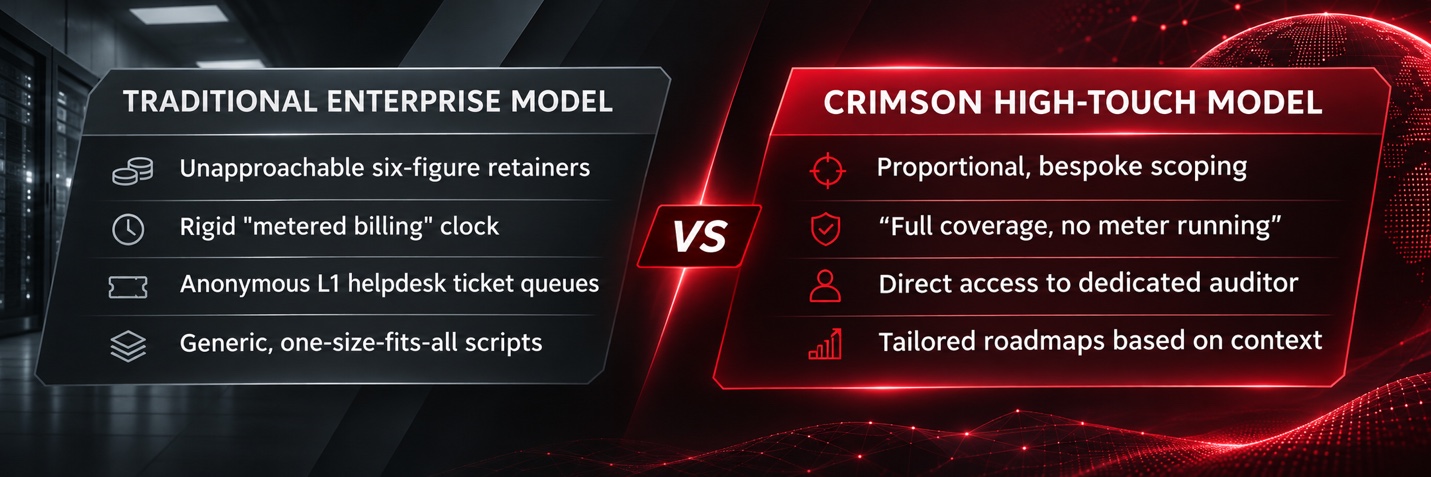
Comparing Organizational Postures
Posture Dimension | The Reactive Approach | Enterprise Retainer Model | The Crimson Security Partnership |
|---|---|---|---|
Engagement Model | Ad-hoc emergency response post-breach. | Rigid annual contracts with strict hourly quotas. | Continuous advisory relationship with dedicated oversight. |
Billing Predictability | Uncontrolled incident cleanup costs. | High entry barriers; additional billing for out-of-scope work. | Bespoke scoping: full coverage without the meter running. |
Auditor Relationship | None; reliance on automated endpoint tools. | Rotated junior tier-1 analysts across client accounts. | Direct access to experienced, senior security professionals. |
Architecture Tailoring | Generic default settings and commercial plug-ins. | Heavy, complex stacks requiring dedicated management. | Pragmatic safeguards matched to actual operational risk. |
The Human Touch in a High-Tech World
Technology alone does not stop sophisticated adversaries; experienced human analysis does. Automated scanners identify known signatures, but seasoned auditors evaluate the human workflows, third-party integrations, and edge configurations that software overlooks.
With more than 20 years of proven industry experience, Crimson Security Inc. — Canada grounds high-level threat defense in practical business operations. Security should enable organizational growth, protect client confidentiality, and satisfy compliance demands without paralyzing day-to-day productivity.
Core Strategic Focus Areas
Precision vulnerability and attack surface audits: Mapping external and internal attack vectors before adversaries exploit them, prioritizing fixes based on exploitability rather than theoretical risk scores.
Dedicated auditor oversight: Direct collaboration with a dedicated professional who understands your industry, organizational workflows, and regulatory environment.
Regulatory and compliance alignment: Translating complex frameworks, from SOC 2 Type II to ISO/IEC 27001 and Canadian privacy mandates, into structured, achievable operational roadmaps.
Proactive incident readiness and remediation: Developing actionable containment playbooks, incident response procedures, and staff awareness programs that neutralize intrusions in minutes instead of months.
Putting It Into Practice
Defending your enterprise does not require endless compromise or unpredictable retainer fees. Whether safeguarding sensitive intellectual property, managing patient records, or securing customer payment pipelines, organizations of every size deserve uncompromised, battle-tested defense.
To evaluate your current risk posture or discuss tailored security roadmaps with a dedicated Canadian auditor, connect with the team at Crimson Security Inc. — Canada by visiting crimsonsecurityinc.ca or contacting our advisory desk directly.